Stock Alerts and Stockout Prevention: How Real-Time Monitoring Protects Your Business
Discover the true cost of stockouts, learn about different alert types, and find out how to configure an effective alert strategy that keeps your inventory healthy.
Stock Alerts and Stockout Prevention: How Real-Time Monitoring Protects Your Business
A customer walks into your store or visits your online shop, ready to buy. The product they want is listed in your catalog, but when they try to purchase it, the item is out of stock. In that moment, you have not just lost a sale -- you may have lost a customer permanently.
Stockouts are one of the most damaging yet preventable problems in inventory management. They erode customer trust, disrupt operations, and quietly drain revenue in ways that rarely show up on a simple profit-and-loss statement. The good news is that with the right alert strategy and monitoring tools, most stockouts are entirely avoidable.
The True Cost of Stockouts
Direct Revenue Loss
The most obvious cost is the sale that did not happen. But the impact extends beyond a single transaction. If a customer needed that product for a project, they may purchase an entire basket of related items from a competitor instead.
Customer Attrition
Studies in retail consistently show that 20% to 40% of customers who encounter a stockout will switch to a different retailer -- and many will not come back. For SMBs competing against larger players, every customer relationship matters.
Operational Disruption
For businesses where inventory feeds production or service delivery, a stockout can halt entire workflows. A missing component on a manufacturing line creates cascading delays that cost far more than the item itself.
Emergency Ordering Costs
When a stockout forces an urgent reorder, you lose negotiating leverage. Rush shipping fees, premium pricing, and the overhead of expedited procurement all add up.
Types of Stock Alerts Every Business Needs
Not all inventory problems look the same, and your alert strategy should reflect that. Effective stock monitoring relies on multiple alert types working together to give you a complete picture.
Minimum Threshold Alerts (Low Stock)
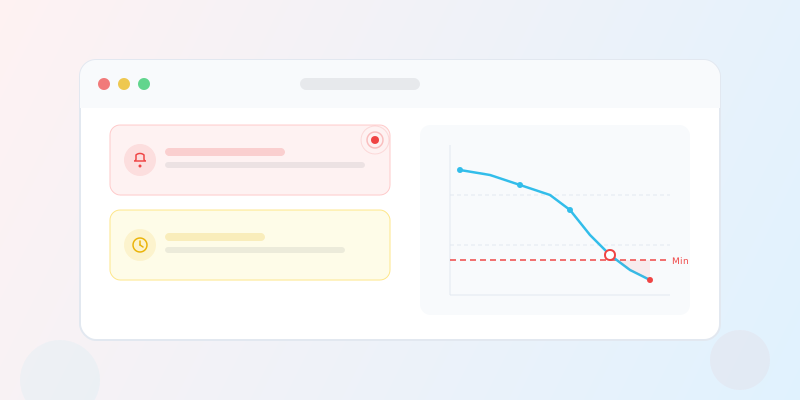
This is the most fundamental alert type. You define a minimum stock quantity for each product -- either globally or per branch -- and the system notifies you when stock drops to or below that level.
To set effective thresholds, consider your average daily sales velocity, supplier lead time, and a safety stock buffer. A common formula is: Reorder point = (average daily demand x lead time in days) + safety stock. For a product selling 10 units per day with a 5-day lead time and a 20-unit buffer, your threshold would be 70 units.
Do not set the same threshold for every product. High-velocity items need higher thresholds, while slow-moving products need only minimal buffers. Review thresholds quarterly based on actual sales patterns.
Expiry Alerts
For businesses dealing with perishable goods -- food, pharmaceuticals, cosmetics, chemicals -- expiry management is critical. Expiry alerts notify you when products approach their use-by date, giving you time to take action before inventory becomes waste.
Effective expiry alerting should operate at multiple time horizons:
- Long-range alerts (30-90 days out): Flag items for promotional pricing or priority selling to move them before they expire.
- Medium-range alerts (7-30 days out): Trigger markdowns, bundle offers, or transfers to higher-volume locations.
- Critical alerts (under 7 days): Identify items that need immediate action -- deep discounts, donation, or disposal planning.
Combine expiry alerts with lot tracking so you know exactly which batch is approaching expiration and where it is located. This prevents blanket markdowns when only a specific lot is at risk.
Trend-Based Alerts
Threshold alerts are static -- they trigger at a fixed number. Trend-based monitoring watches the rate of change in your stock levels and flags unusual patterns. If a product normally sells 50 units per week but suddenly moves at 120 units per week, a trend alert warns you that stock will run out faster than expected -- even before you hit your minimum threshold. Conversely, if sales drop sharply, trend detection helps you avoid over-ordering.
Trend alerts are most valuable for products with variable demand -- seasonal items, promoted goods, or products tied to external factors like weather.
Configuring an Effective Alert Strategy
Prioritize by Business Impact
Not every product deserves the same monitoring attention. Classify your inventory: critical items (top revenue generators) need tight monitoring and immediate alert routing; important items warrant standard thresholds with reasonable buffers; low-priority items need only basic alerts where occasional stockouts are tolerable.
Route Alerts to the Right People
An alert is only useful if it reaches someone who can act. Branch-specific alerts should go to the branch manager, expiry alerts for regulated products to the compliance team, and high-value stockout risks to procurement or senior management.
Avoid Alert Fatigue
If your team receives dozens of alerts daily, the critical ones get lost in the noise.
Start with alerts on your top 20% of products by revenue. It is better to have 30 well-managed alerts than 300 that nobody reads. Expand coverage gradually once your team builds a reliable response rhythm.
Review and Adjust Regularly
Static thresholds become stale. Schedule quarterly reviews of your alert parameters and adjust them based on recent demand data, supplier reliability, and changes in your product mix.
How ISA Keeps You Ahead of Stockouts
ISA provides a stock alert system designed for businesses that cannot afford to leave inventory monitoring to chance. Configure minimum stock thresholds at both the global product level and the individual branch level, ensuring each location's unique demand patterns are respected.
For perishable or date-sensitive inventory, ISA's lot tracking and expiry alert system monitors product units by batch, notifying you as expiration dates approach. Every alert includes full context -- the product, branch, current quantity, and trigger threshold -- so you can make informed decisions without digging through reports. Alerts can be acknowledged and tracked, creating an audit trail of your team's response to inventory risks.
ISA updates stock quantities in real time as movements are recorded, so alerts reflect what is actually happening, not what a nightly batch process reported hours ago. Combined with the procurement module, you can move from a low-stock alert to a purchase order within the same platform.
Building a Culture of Proactive Inventory Management
Technology alone does not prevent stockouts. The most effective businesses combine good tools with good habits:
- Make alert response part of daily routines. Designate time each morning for reviewing and acting on stock alerts.
- Track response metrics. A three-day-old unacknowledged alert is a process failure, not a technology problem.
- Learn from every stockout. Was the threshold too low? Was an alert ignored? Each incident is a chance to refine your system.
With the right alert types, routed to the right people, and acted upon consistently, stockouts become the exception rather than the norm.